Béziers, France
- 74,081 people
- 17 places to visit
- 43.3442, 3.2158
Places to Visit (17)
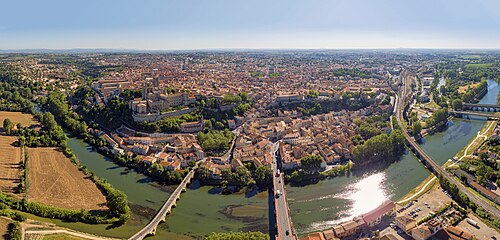
Béziers is a historic city situated in the Occitanie region of southern France, known for its rich cultural heritage and picturesque landscapes. Located on the banks of the Orb River, Béziers is approximately 15 kilometers from the Mediterranean Sea and serves as a significant agricultural and commercial center in the Languedoc region. With a population of around 75,000 inhabitants, the city has a vibrant community and is renowned for its numerous festivals, including the famous Feria de Béziers, a celebration of music, culture, and local traditions that draws thousands of visitors each August.
Historically, Béziers traces its origins back to ancient times, with evidence of settlement dating back to the 6th century BC. The city became an important Roman outpost, known as "Béziers," and played a strategic role in the region's history, especially during the Crusades and the Wars of Religion. Today, the city's architecture reflects its past, featuring narrow medieval streets, the imposing Saint-Nazaire Cathedral, and several historic buildings, such as the Pont Vieux, a medieval bridge that spans the Orb River. The city's diverse architectural styles are complemented by its beautiful parks and gardens, offering residents and visitors ample opportunities for leisure and recreation.
The local economy has evolved, with agriculture, especially wine production, remaining a key sector. Béziers is situated in one of France's prominent wine regions, known for producing a variety of wines, particularly those made from the Languedoc grape varieties. The city also benefits from its proximity to major transport routes, including rail and road networks, which facilitate trade and tourism. Béziers is well-connected to other notable destinations in the region, including Montpellier and Narbonne, making it an attractive location for both residents and tourists. With its blend of history, culture, and economic vitality, Béziers remains a significant city in southern France, embodying the charm and character of the Occitanie region.
Facts about Béziers
- Béziers is one of the oldest cities in France, founded over 2,500 years ago, and is often associated with the ancient Roman and pre-Roman settlements.
- The city is famous for its annual Feria de Béziers, a vibrant festival that celebrates local culture with bullfighting, music, and traditional events, attracting thousands of visitors each August.
- Béziers is located on the Canal du Midi, a UNESCO World Heritage site, and is known for its beautiful canal bridges and lock systems, showcasing remarkable 17th-century engineering.
- The city is renowned for its wine production, particularly the local Coteaux de Béziers wines, contributing significantly to the Languedoc's reputation as a prominent wine region.
- Béziers is home to the stunning Saint-Nazaire Cathedral, a magnificent Gothic structure that offers panoramic views of the city and the surrounding vineyards.
- The city has a rich history of conflict, notably being the site of the massacre during the Albigensian Crusade in the 13th century, which plays a significant role in its historical narrative.
- The arena in Béziers, built in 1897, is one of the oldest bullrings in the region and is a central venue for both bullfighting events and cultural performances.
- Béziers is known for the 'Les Neuf Écluses', or the Nine Locks of Fonseranes, where boats navigate a series of nine locks, representing a significant feat of hydraulic engineering.
- The city has historic ties to the poet Paul Valéry, who was born in nearby Sète, making Béziers part of the broader literary culture of the region.
- Béziers boasts a strong sculpture culture, exemplified by the monument to the poet Louis Brauquier, reflecting the city's artistic heritage and commitment to the arts.