Chongqing, China
- 7,457,599 people
- 9 places to visit
- 29.5657, 106.5512
Places to Visit (9)
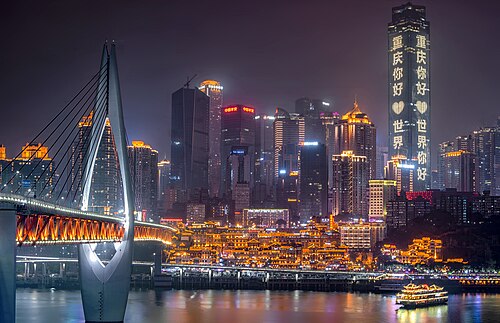
Chongqing is a major city located in southwestern China, known for its unique topography, cultural diversity, and rapid economic development. Covering an area of approximately 82,403 square kilometers, it is one of the largest municipalities in China, directly under the central government. Chongqing sits at the confluence of the Yangtze and Jialing Rivers, and its hilly terrain has earned it the nickname "Mountain City." The region has a rich historical background dating back over 3,000 years, with significant developments during the Ming and Qing dynasties. Today, it is recognized as one of the most populous cities in the world, with a population exceeding 30 million, due in part to the migration of rural populations into urban areas.
The city is a vital economic hub in China, serving as a center for commerce, finance, and transportation. Chongqing's strategic location along the Yangtze River enhances its role in trade, connecting the interior of China to international markets. The city has experienced rapid industrial growth, particularly in sectors like automotive manufacturing, electronics, and heavy industries. Additionally, Chongqing is known for its robust agricultural production, particularly citrus fruits and rice, benefiting from its fertile soil and favorable climate. In recent years, the government has invested heavily in infrastructure projects, such as the construction of bridges, highways, and high-speed railways, further enhancing its connectivity and economic potential.
Culturally, Chongqing is renowned for its spicy cuisine, most notably its hot pot, which has gained popularity both domestically and internationally. The city offers a vibrant arts scene, with numerous festivals celebrating traditional music, dance, and theater. Chongqing's urban landscape is characterized by a blend of modern skyscrapers and historical architecture, notably the ancient pagodas and temples that dot its hillsides. The city's distinct dialect and customs reflect the diversity of its population, which includes various ethnic groups, adding to its rich cultural tapestry. As a dynamic blend of tradition and modernity, Chongqing continues to attract tourists, businesses, and scholars, making it an essential part of China's evolving narrative in the 21st century.
Facts about Chongqing
- Chongqing is one of the four direct-controlled municipalities of China, along with Beijing, Shanghai, and Tianjin, which means it has the same administrative level as a province.
- The city is known for its unique geographical location at the confluence of the Yangtze and Jialing Rivers, offering stunning views and a distinct landscape of hills and rivers.
- Chongqing is famous for its hot pot cuisine, a culinary style that is characterized by spicy broth and a variety of ingredients cooked at the table, making it a major gastronomic destination in China.
- As a major center for the shipping industry, Chongqing is often referred to as the 'Mountain City' due to its steep terrain and is a key part of the Yangtze River's shipping route.
- The city has a rich history and served as the Nationalist government's wartime capital during the Second Sino-Japanese War, which is reflected in its numerous historical sites.
- Chongqing is home to the Dazu Rock Carvings, a UNESCO World Heritage Site featuring a series of Buddhist sculptures and inscriptions dating back to the 7th century.
- The city is noted for its vibrant nightlife, marked by its numerous bars, nightclubs, and cultural performances, making it a lively urban center.
- Chongqing is renowned for its unique architecture, such as the iconic Hongya Cave, a stilted building complex that showcases traditional wooden architecture amidst modern designs.
- The city's unique culture blends influences from various ethnic groups, including the Tujia and Miao peoples, which is evident in its festivals, music, and arts.
- Chongqing hosts the International Hot Pot Food Festival, celebrating its culinary heritage and attracting food lovers from across the country and beyond.