Constanţa, Romania
- 317,832 people
- 18 places to visit
- 44.1759, 28.6519
Places to Visit (18)
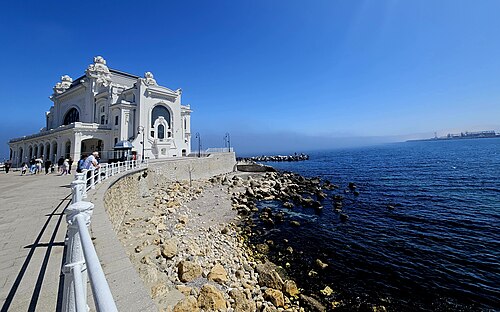
Constanţa is a prominent port city located on the western coast of the Black Sea in Romania. It is the oldest continuously inhabited city in the country, with roots that trace back over 2,500 years when it was originally founded by the Greeks as Tomis in the 6th century BCE. Throughout its history, Constanţa has been a significant maritime hub due to its strategic location and has witnessed the rise and fall of various civilizations, including the Greeks, Romans, Byzantines, and Ottomans. The city is an important cultural and economic center, contributing notably to Romania's maritime trade and tourism sectors.
Modern Constanţa is characterized by its diverse architectural styles, reflecting its rich historical tapestry. The city's iconic landmark, the Constanţa Casino, exemplifies the grandeur of early 20th-century architecture, albeit now in a state of disrepair. Other notable sites include the Roman Edifice with Mosaic, the Great Mahmudiye Mosque, and the National History and Archaeology Museum, which showcases artifacts from various periods of the city's history. Constanţa also serves as a gateway to the popular seaside resorts along the Black Sea coast, such as Mamaia, known for its sandy beaches and vibrant nightlife. The city's economy is bolstered not only by tourism but also by its role as an essential shipping and cargo port, handling a significant portion of Romania's maritime traffic.
Demographically, Constanţa is a vibrant multicultural city that has historically been home to various ethnic groups, including Romanians, Greeks, Turks, and Tatars. As of the latest census, the population stands at approximately 300,000 residents, making it one of Romania's largest cities. The city is well-connected through major transport networks, including road, rail, and air, enhancing its accessibility. Education in Constanţa is supported by several universities and educational institutions, fostering a young and dynamic population. Today, Constanţa continues to be a focal point for trade, culture, and tourism, embracing its rich historical legacy while looking towards a future of growth and development.
Facts about Constanţa
- Constanţa is the oldest continuously inhabited city in Romania, with a history dating back over 2,500 years to its founding by Greek colonists as Tomis.
- The city is home to the largest port on the Black Sea, known as the Port of Constanţa, which significantly contributes to Romania's economy and trade.
- Constanţa features the famous Roman Edifice with Mosaic, a stunning archaeological site showcasing intricate mosaics from the Roman period, attracting tourists and historians alike.
- The city is known for the iconic Casino of Constanţa, an Art Nouveau building constructed in the early 20th century, which is a symbol of the city's Belle Époque era.
- Constanţa is a cultural hub, hosting the National Museum of History and Archaeology, which houses many artifacts from its ancient past, including the unique Tomb of the Woman with the Hat.
- The city has a diverse architectural landscape, integrating various styles due to its multicultural history, including Ottoman, Greek, Roman, and Modern influences.
- Constanţa celebrated its 2000th anniversary as a city in 2000, reflecting its historical significance in the region.
- The Ovid Square in Constanţa is named after the Roman poet Ovid, who was famously exiled to Tomis, and features a statue of him surrounded by significant historical buildings.
- Constanţa hosts the annual Aqua Magic festival, which is one of the largest water-themed events in Romania and draws thousands of visitors each summer.
- The city's beach resort, Mamaia, is renowned for its vibrant nightlife and is one of the most popular summer destinations in Romania, attracting both local and international tourists.