Fulda, Germany
- 63,760 people
- 17 places to visit
- 50.5558, 9.6808
Places to Visit (17)
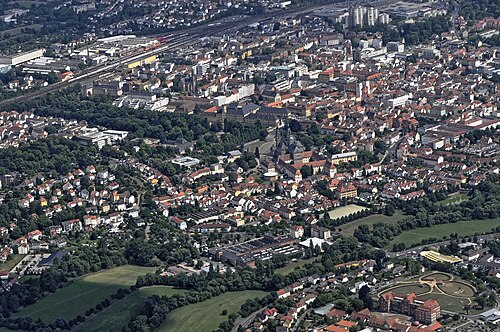
Fulda is a city located in central Germany, known for its rich history, cultural heritage, and picturesque landscapes. As the capital of the district of the same name in the state of Hesse, Fulda serves as an important administrative and economic hub. The city was founded in the 8th century around a Benedictine monastery established by Saint Sturm, a disciple of Saint Boniface, the missionary who played a key role in the Christianization of Germany. This monastery became a center of religious and cultural life in the region, leading to Fulda's development as a significant town during the Middle Ages. By the late 17th century, Fulda was elevated to the status of a principality, which further facilitated its growth and prominence.
Fulda's architecture reflects its historical significance, featuring a blend of Baroque, Gothic, and contemporary styles. The Fulda Cathedral, built between 1704 and 1712, is a striking example of Baroque architecture and serves as the city's most prominent landmark. The cathedral houses the tomb of Saint Sturm and boasts a richly decorated interior, attracting numerous visitors each year. Additionally, the city's Old Town showcases beautifully preserved half-timbered houses, cobblestone streets, and the notable Orangerie and Palace Gardens, which exemplify the elegance of the Baroque period. Fulda's cultural life is vibrant, with various festivals, markets, and events throughout the year, such as the popular Fulda Christmas Market, which draws tourists and locals alike.
Economically, Fulda has transitioned from a historical center of ecclesiastical power to a modern, diverse economy. The city hosts a mix of industries, including manufacturing, logistics, and services, making it an attractive location for businesses. As a transportation hub, Fulda is well-connected by the autobahn and railway networks, providing easy access to larger cities like Frankfurt and Kassel. Furthermore, the presence of educational institutions, including the University of Applied Sciences Fulda, contributes to the city's dynamism and innovation. With its unique blend of history, culture, and modernity, Fulda continues to be a noteworthy destination in Germany, appealing to both tourists and residents.
Facts about Fulda
- Fulda is known for its stunning Baroque architecture, particularly the Fulda Cathedral, which dates back to the 18th century and is a UNESCO World Heritage site candidate.
- The city is home to the oldest university in Hesse, the University of Applied Sciences Fulda, established in 1971, which focuses on applied sciences and has a strong international presence.
- Fulda's historical significance is highlighted as a center of the Benedictine monastic movement; the Fulda Abbey was founded by Saint Sturm in the 8th century, becoming a major cultural and religious influence.
- The city's location at the crossroads of major trade routes has made it a significant economic hub throughout history, linking southern and northern Germany.
- Fulda is renowned for its annual 'Fulda Christmas Market,' one of the oldest and most charming in the region, attracting visitors with its traditional crafts and holiday spirit.
- The 'Fulda Rose,' a unique hybrid rose developed in the region, highlights the city's commitment to horticulture and has gained recognition for its beauty.
- Fulda hosts the 'Fuldaer Weihnachtsmarkt,' which boasts a long-lasting tradition, with roots tracing back to the 15th century, making it one of the oldest Christmas markets in Germany.
- The city is famous for its well-preserved medieval old town, which offers a blend of historical buildings, colorful half-timbered houses, and vibrant squares that are distinct from other cities.
- Fulda is significant in German history for its role during the Reformation, particularly as it was a center of counter-Reformation efforts in the 16th century.
- The 'Wasserkuppe,' located nearby, is renowned as the birthplace of modern gliding and is popular for aviation sports, distinguishing Fulda from other cities that do not have such aviation heritage.