Gao, Mali
- 133,110 people
- 3 places to visit
- 16.264, -0.028
Places to Visit (3)
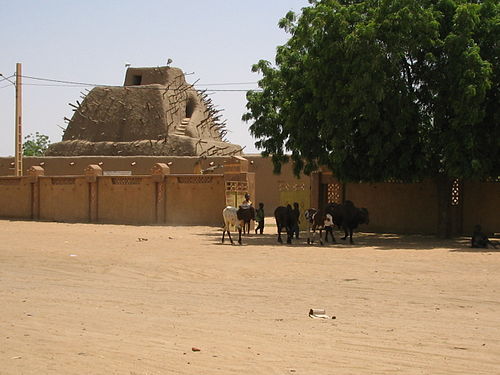
Gao is a significant city located in eastern Mali, positioned along the banks of the Niger River. It serves as the capital of the Gao Region and has a rich historical background, deeply rooted in the ancient empires of West Africa. Historically, Gao was the capital of the Songhai Empire, one of the largest empires in African history, flourishing from the 15th to the 16th centuries. Its strategic location allowed it to prosper as a center for trade, particularly in gold, salt, and other commodities. The city's architectural landscape reflects its storied past, with remnants of the empire visible in its structures, alongside new developments that have arisen in the modern era.
The population of Gao is diverse, comprising various ethnic groups including the Songhai, Tuareg, and Bambaras. This cultural mosaic contributes to the city’s vibrant atmosphere, with traditional practices coexisting alongside contemporary influences. Despite its historical significance, Gao has faced challenges in recent years, particularly due to political instability and conflict that began in 2012. The situation affected not only the security of the region but also the preservation of its cultural heritage. International efforts, including those by the United Nations and Mali's government, have been made to stabilize the area and promote development, but challenges remain. Nevertheless, Gao continues to be an important hub for commerce and culture in Mali, holding onto its historical legacy while looking towards a more stable future.
Facts about Gao
- Gao was historically one of the major trading centers of the trans-Saharan trade, connecting West Africa with North Africa.
- The city is home to the Tomb of Askia, a UNESCO World Heritage site and an important example of the Sudano-Sahelian architectural style.
- Gao served as the capital of the Songhai Empire in the 15th century, which was one of the largest empires in African history.
- The Niger River runs through Gao, providing a vital waterway for transport and trade, which is crucial for its economy.
- Gao has a unique cultural blend of ethnic groups, including the Songhai, Tuareg, and Bambara, each contributing to the city’s rich cultural tapestry.
- The city is known for its vibrant market scenes, where a variety of local goods, including handicrafts and spices, are traded.
- Gao has experienced significant historical changes due to colonialism and recent conflicts, which sets it apart from more stable regions in Mali.
- The Gao region is known for its agricultural production, particularly millet and sorghum, which is essential for local food security.
- Gao is also recognized for the annual cultural festival that celebrates the city's historical significance and its diverse traditions.
- The city has a distinct architectural style featuring adobe structures that reflect its rich historical lineage and adaptation to the Sahelian environment.