Ḩamāh, Syria
- 460,602 people
- 7 places to visit
- 35.1408, 36.7553
Places to Visit (7)
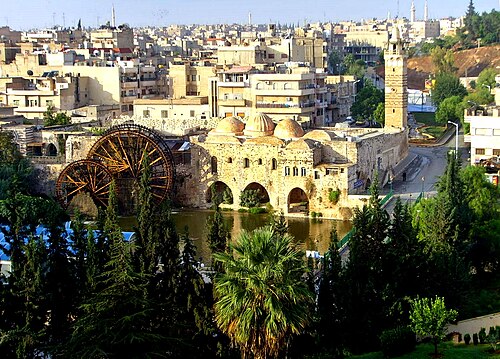
Ḩamāh is a historical city located in western Syria, positioned along the banks of the Orontes River. It is the capital of the Hama Governorate and is known for its rich cultural heritage and significance as a trading center. Historically, Ḩamāh has been inhabited since ancient times, with references to its existence dating back to the ancient Romans and further connections to various Islamic caliphates. The city's architecture features a blend of these historical influences, with notable structures such as the Great Mosque of Ḩamāh, built in the 12th century, and several famous ancient waterwheels known as "noria." These innovative structures served both practical and aesthetic purposes, demonstrating the ingenuity of the region's historical water management systems.
Ḩamāh has played a pivotal role in Syria's modern history, particularly during the 20th century. It experienced significant political strife in the 1970s and 1980s, notably during the Hama Massacre in February 1982, when government forces suppressed an uprising by the Muslim Brotherhood. This tragic event resulted in the loss of thousands of lives and had a profound impact on the city's demographic and political landscape. The city has faced challenges in contemporary times, particularly as a result of the ongoing Syrian Civil War, which began in 2011. Despite this, Ḩamāh has maintained its cultural vibrancy, with ongoing efforts to preserve its historical sites and promote tourism, which features its ancient ruins, charming streets, and the famous norias. As a city that embodies resilience, Ḩamāh continues to be a symbol of Syria's complex history, reflecting the struggles and achievements of its people over the centuries.
Facts about Ḩamāh
- Ḩamāh is renowned for its historic water wheels, known as 'noriah', which have been used for centuries to irrigate the surrounding fields and are a symbol of the city's agricultural heritage.
- The city is home to the ancient ruins of the Roman temple complex at Apamea, which was once a major city in the Roman Empire and features impressive remains of colonnades and theaters.
- Ḩamāh played a significant role during the Ottoman Empire and features a blend of Ottoman and Islamic architecture in its old town.
- The city was a key center of the Arab Revolt against Ottoman rule in the early 20th century, reflecting its historical significance in regional independence movements.
- Ḩamāh is notably known for the 1982 uprising against the Syrian government, where a significant crackdown led to a tragic loss of life, marking a pivotal moment in the country's contemporary history.
- The city's location at the Orontes River makes it strategically important for agriculture, particularly for the cultivation of cotton and various fruits.
- Ḩamāh hosts the open-air museum of the old city, showcasing traditional Arabic architecture and urban design that dates back centuries.
- The city is distinguished by its unique blend of diverse religious communities, including Sunni Muslims, Alawites, and Christians, contributing to a rich cultural mosaic.
- Ḩamāh has produced notable figures in Syrian literature and poetry, contributing significantly to Arab culture and intellectual thought.
- The city is often referred to as Syria's 'City of Water' due to its extensive historical reliance on irrigation and its scenic water features.