Khartoum, Sudan
- 1,974,647 people
- 14 places to visit
- 15.5974, 32.5356
Places to Visit (14)
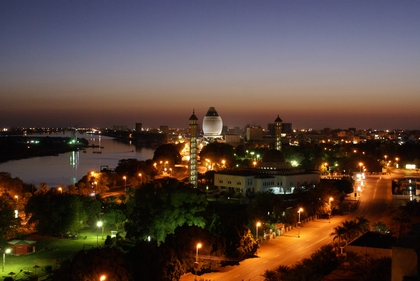
Khartoum, the capital city of Sudan, serves as the political, cultural, and economic center of the country. Located at the confluence of the Blue Nile and White Nile rivers, Khartoum is part of a larger metropolitan area that includes Omdurman and Khartoum North, making it the third-largest city in Africa. With a population exceeding 5 million, it stands as a vibrant hub with a rich history, influenced by various cultures and civilizations over millennia. The city's landscape is characterized by a mix of modern architecture, historical buildings, and traditional markets, reflecting its diverse heritage.
Historically, Khartoum was founded in 1821 by the Ottoman Empire as a garrison town and has since evolved into a significant administrative and commercial center. The city is home to several notable landmarks, including the Presidential Palace, the National Museum of Sudan, and the Great Mosque, showcasing the country's Islamic heritage. Khartoum's educational institutions, such as Sudan University of Science and Technology and the University of Khartoum, emphasize the city's role as an academic center. The city also serves as a vital transit point for trade between North and Sub-Saharan Africa, with its economy supported by agriculture, manufacturing, and services.
Despite its dynamic growth, Khartoum faces numerous challenges, including political unrest, economic difficulties, and infrastructural deficits. Recent decades have seen significant transformations, particularly following the Sudanese Revolution in 2019, which led to a transitional government aimed at establishing a democratic system. The city's inhabitants have shown resilience, often engaging in civic activism and cultural expression. Khartoum remains a city where tradition and modernity coalesce, serving as a testament to Sudan's complex history and its potential future.
Facts about Khartoum
- Khartoum is the capital and largest city of Sudan, serving as the political and administrative center of the country.
- The city is uniquely located at the confluence of the Blue Nile and White Nile rivers, a geographical feature that distinguishes it from other cities in Sudan.
- Khartoum is home to the National Museum of Sudan, which houses a vast collection of artifacts from ancient Nubia and Pharaonic Sudan, unlike other towns that may have local museums.
- The city boasts several prominent educational institutions, including the University of Khartoum, the oldest university in Sudan, founded in 1902.
- Khartoum hosts the annual Khartoum International Film Festival, making it one of the cultural hubs of Sudan, compared to more localized events in other regions.
- The capital city has a diverse architectural landscape featuring the iconic Sudanese Presidential Palace and the historic Al-Mogran area, showcasing a mix of modern and traditional designs.
- Khartoum played a significant role during the Mahdist War (1881-1899) and served as a critical center in the struggle against British colonialism.
- The city's population is ethnically and culturally diverse, home to people from various tribes and communities, making it a melting pot compared to many other towns.
- Khartoum's modern infrastructure includes Khartoum International Airport, one of the most significant airports in Sudan, facilitating international travel to and from the capital.
- Unlike many smaller towns in Sudan, Khartoum has a vibrant nightlife, with restaurants, cafes, and cultural events that cater to a cosmopolitan audience.