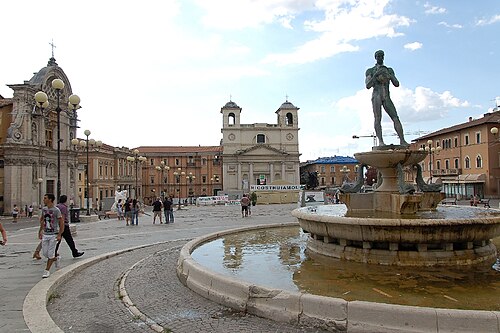
L'Aquila, Italy

  • 33,691 people
  • 13 places to visit
  • 42.3507, 13.3999
Loading...

Places to Visit (13)

1. Basilica of San Bernardino
Historic church with beautiful frescoes.
2. L'Aquila Cathedral
Impressive cathedral with ornate decorations.
3. Fountain of the 99 Cannelle
Ancient fountain featuring 99 spouts.
4. Fortress of L'Aquila
Medieval fortress with panoramic views.
5. Piazza del Duomo
Central square surrounded by historic buildings.
6. National Museum of Abruzzo
Museum showcasing local art and history.
7. Church of Santa Maria di Collemaggio
Important pilgrimage site with a Romanesque facade.
8. Fontana Luminosa
Beautiful illuminated fountain in the city center.
9. Campo Imperatore
Alpine plateau known for its wildflowers and hiking trails.
10. Anfiteatro Romano
Roman amphitheater dating back to the 1st century.
11. Teatro Comunale
Historic theater hosting cultural events.
12. Chiesa di Santa Giusta
Church with a Romanesque bell tower.
13. Chiesa di San Silvestro
Baroque church with ornate decorations.
L'Aquila
L'Aquila 2011 by-RaBoe-197© Ra Boe / Wikipedia Create the proper attribution for your usage by clicking on this button! This file is licensed under the Creative Commons Attribution-Share Alike 3.0 Germany license.Attribution: Ra Boe / Wikipedia You are free: to share – to copy, distribute and transmit the work to remix – to adapt the work Under the following conditions: attribution – You must give appropriate credit, provide a link to the license, and indicate if changes were made. You may do so in any reasonable manner, but not in any way that suggests the licensor endorses you or your use. share alike – If you remix, transform, or build upon the material, you must distribute your contributions under the same or compatible license as the original.https://creativecommons.org/licenses/by-sa/3.0/de/deed.enCC BY-SA 3.0 deCreative Commons Attribution-Share Alike 3.0 detruetrue Internet: Titel Foto: Ra Boe / Wikipedia, Original; Lizenz: CC by-sa 3.0 Print: Titel Foto: Ra Boe / Wikipedia, Lizenz: CC by-sa 3.0 I have published this image as author Ra Boe under the "CC-BY-SA-3.0" in Wikipedia. This means that free, commercial usage outside of Wikipedia is permitted under the following licence terms: Online media: The author " RaBoe/Wikipedia " is named A weblink to the original image is provided: //commons.wikimedia.org/wiki/File:L%27Aquila_2011_by-RaBoe-197.jpg A copy of, or the Uniform Resource Identifier (https://creativecommons.org/licenses/by-sa/3.0/de/legalcode) for, this License with every copy Print media: The author " RaBoe/Wikipedia" is named A copy of, or the Uniform Resource Identifier (https://creativecommons.org/licenses/by-sa/3.0/de/legalcode) for, this License with every copy Please send me a specimen copy or the URL of the website where the image is used. Please write an email to raboe001-at-web.de, if you need the image in a higher resolution need my postal address for sending a specimen copy have further questions about the terms of the licence PS: In case of refusal of the above terms the author reserves the right to take legal action. This license and the rights granted hereunder will terminate automatically upon any breach by you of the terms of this license. In this case the author reserves to demand declaration to cease and desist, and compensation (according to the MFM fee references currently in force). Any of the above conditions can be waived if you get permission from the copyright holder. Foto selbst aufgenommen mit Nikon-D50: Objektiv Tamron 18 - 250 mmvon Wikipedia-User: Ra Boe This photo was taken with an Nikon-D50:, Objective Tamron 18 - 250 mm by Wikipedia user: Ra BoeCC BY-SA 3.0 de

L'Aquila is the capital city of the Abruzzo region in central Italy, situated at an elevation of about 721 meters (2,365 feet) in the Apennine Mountains. Known for its rich history and stunning architecture, the city was founded in the 13th century by Frederick II, Holy Roman Emperor, as part of a network of fortified towns. L'Aquila boasts numerous significant landmarks, including the Basilica di San Bernardino, a stunning example of Renaissance architecture, and the Fontana delle 99 Cannelle, a monumental fountain featuring 99 spouts that symbolize the founding settlements of the city. The cityscape is characterized by medieval structures, baroque churches, and vibrant piazzas, reflecting its historical importance and cultural heritage.

Tragically, L'Aquila gained international attention following the devastating earthquake that struck on April 6, 2009, causing significant damage to its historical architecture and leading to the loss of over 300 lives. The earthquake resulted in extensive restoration efforts, with many buildings and sites undergoing reconstruction to preserve their historical value while integrating modern safety measures. This recovery process has included the restoration of various churches, palaces, and fortifications that are central to L'Aquila's identity. Despite the challenges, the city has been resilient, showcasing its vibrant culture and community spirit through annual festivals, food markets, and local events that emphasize its rich traditions, including the famous “Perdonanza Celestiniana,” a historical celebration that attracts visitors and tourists to the area. Today, L'Aquila stands as a testament to the human spirit, balancing its historical legacy with ongoing recovery efforts and revitalization.

Facts about L'Aquila

  • L'Aquila is located in the Abruzzo region of Italy and is known for its stunning mountainous landscapes and medieval architecture.
  • The city was founded in 1254 by a group of surrounding towns and was named 'L'Aquila', which means 'The Eagle', symbolizing power, courage, and freedom.
  • L'Aquila is home to the Basilica di Santa Maria di Collemaggio, where Pope Celestine V is buried; it is also famous for being the site of the first Jubilee in 1294.
  • The city was devastated by a major earthquake in 2009 that caused significant damage to its historic center and has since undergone a long and complex reconstruction process.
  • L'Aquila has a lively cultural scene and is famous for its annual folklore, music, and arts festival called 'Festa di San Domenico' that promotes local traditions.
  • The historic center of L'Aquila hosts several unique architectural landmarks, including the imposing 16th-century Forte Spagnolo (Spanish Fortress).
  • The city is known for its traditional cuisine, highlighting dishes like 'arrosticini' (skewered lamb) and 'timballo', a baked pasta dish often made with local ingredients.
  • L'Aquila is also part of the Gran Sasso e Monti della Laga National Park, which offers opportunities for outdoor activities such as hiking, skiing, and climbing.
  • The city features a network of 'Fontanoni' (large fountains) built during the medieval period, which still supply fresh spring water to residents today.
  • L'Aquila has a rich historical significance as it was once the seat of the 'Repubblica Aquilana' and played a key role in the political landscape of medieval Italy.
Some of this text is AI generated and may not be accurate.