Magdeburg, Germany
- 235,775 people
- 19 places to visit
- 52.1132, 11.6081
Places to Visit (19)
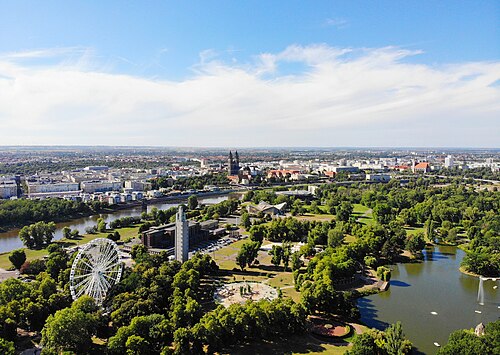
Magdeburg, the capital of the federal state of Saxony-Anhalt in Germany, is situated along the Elbe River. With a history spanning over a millennium, it was first documented in 805 AD when it became a significant center for trade and commerce. Its strategic location facilitated connections between the Hanseatic League cities and furthered its development as a vibrant hub of culture and politics throughout the Middle Ages. Magdeburg's status was further enhanced when it became the residence of Otto I, the first Holy Roman Emperor, who established the city as a political and ecclesiastical center, leading to the founding of the esteemed Magdeburg Cathedral.
The city experienced significant hardships during the Thirty Years' War, suffering vast destruction and a devastating decline in population. However, the subsequent reconstruction and urban development laid the groundwork for Magdeburg’s transformation into an industrial center in the 19th century, becoming known for its manufacturing capabilities, notably in the metal and machine sectors. The city also played a crucial role during both World Wars, suffering extensive damage in World War II, but it rebounded quickly in the post-war years and entered a period of modernization. Magdeburg is recognized today for its architectural blend of historic and contemporary structures, including the iconic Elbauenpark, which hosted the Federal Garden Show in 1999, and the magnificent Magdeburg Water Bridge, the longest navigable aqueduct in the world, which symbolizes the city's commitment to innovation and infrastructure advancement.
Culturally, Magdeburg boasts a rich tapestry of theaters, museums, and galleries, reflecting its vibrant artistic scene. The city hosts numerous annual events, such as the Magdeburg Christmas Market, attracting visitors from near and far. Educationally, it is home to several institutions, including the Otto von Guericke University, which contributes to the city’s youthful energy and innovative spirit. Despite the challenges faced throughout its history, Magdeburg has emerged as a resilient and modern city, blending its historical significance with contemporary advancements, making it a captivating destination in Germany.
Facts about Magdeburg
- Magdeburg is the capital of the federal state of Saxony-Anhalt and has a history dating back over 1,200 years.
- The city is home to the Magdeburg Cathedral, which is the first Gothic cathedral built in Germany and features two towering spires.
- Magdeburg was the site of the Magdeburg rights, one of the earliest examples of urban law in the Holy Roman Empire, which granted towns certain autonomy.
- The Elbe River, which runs through Magdeburg, played a crucial role in the city’s trade history and is a significant waterway in Europe.
- Magdeburg is known for its unique ‘Magdeburg hemispheres’ experiment, demonstrating the power of atmospheric pressure, conducted by Otto von Guericke in the 17th century.
- The city experienced heavy destruction during World War II but has since undergone extensive reconstruction, with a blend of modern and historic architecture.
- Magdeburg hosts the annual Magdeburg Music Festival, celebrating diverse musical genres and attracting artists from across the globe.
- In 2005, Magdeburg was awarded the title 'UNESCO City of Science' for its commitment to research and education.
- The city is often referred to as the 'Green City’ due to its extensive parks and green spaces, including the famous Elbauenpark.
- Magdeburg is also notable for its innovative public transportation system, which includes the Magdeburg Light Rail, the first light rail system in Germany introduced in the early 1990s.