Male, Maldives
- 103,693 people
- 17 places to visit
- 4.1753, 73.5091
Places to Visit (17)
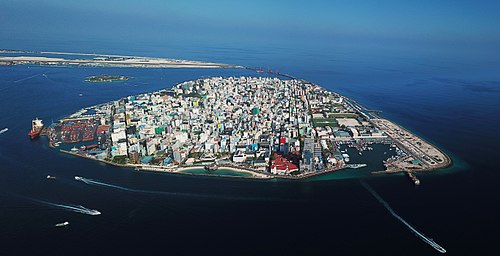
Malé is the capital city of the Maldives, an island nation located in the Indian Ocean, southwest of Sri Lanka. With a population of approximately 200,000, it is one of the most densely populated cities in the world. Malé serves as the political, economic, and cultural center of the Maldives, housing the majority of the country’s government offices, foreign embassies, and media outlets. The city is situated on the island of the same name, which is one of the smallest capital islands globally, encompassing an area of just about 9.27 square kilometers. Surrounded by the azure waters of the Indian Ocean, Malé is characterized by its vibrant urban landscape, featuring a mix of modern buildings and traditional Maldivian structures.
The history of Malé dates back over a thousand years, with significant influences from various cultures, including Indian, Arab, and European traders. This rich heritage is reflected in its architecture, markets, and local customs. Key landmarks in Malé include the Maldives Islamic Centre, which showcases stunning Islamic architecture and houses the country's largest mosque, Masjid-al-Sultan Muhammad Thakurufaanu Al-Azeem. The city is also home to the National Museum, which preserves and exhibits the history and culture of the Maldives from its ancient origins to the modern era. The bustling fish market and vibrant local markets are popular attractions, offering visitors a glimpse of traditional Maldivian life and a chance to taste local cuisine.
Despite its small size, Malé offers various amenities and services, including schools, hospitals, parks, and sports facilities. The public transportation system is efficient, with buses and ferries providing access to neighboring islands. As the gateway to the rest of the Maldives, Malé is a hub for travelers heading to the nation’s renowned resort islands, providing essential services and connections to various tourist destinations. While it experiences challenges due to overcrowding and environmental concerns, including rising sea levels, efforts are underway to promote sustainable urban development and environmental protection. Overall, Malé is a unique city that combines a rich cultural heritage with contemporary urban life, making it an essential part of the Maldives.
Facts about Male
- Malé is the capital city of the Maldives and is the political, economic, and cultural center of the country.
- Malé is one of the densest populated cities in the world, with approximately 220,000 residents living in just over 9 square kilometers.
- The city is home to the Maldives Islamic Centre, which features a stunning golden dome and serves as a central place for Islamic worship and community events.
- Malé has a unique mixture of modern and traditional Maldivian architecture, with colorful buildings and significant colonial structures like the Old Friday Mosque, built from coral stone.
- The city is known for its vibrant markets, such as the Malé Fish Market, where fresh fish and local produce are sold, reflecting the country's fishing economy.
- Malé is also famous for its annual celebrations, including the Republic Day, which commemorates the abolition of the monarchy in 1968.
- The National Museum of the Maldives, located in Malé, showcases the rich history and culture of the islands, housing artifacts from the Maldivian royal era and earlier.
- Unlike many other islands in the Maldives, Malé is one of the few places where you can experience urban life with cafes, shops, and a bustling street scene.
- Malé has a unique geography, as it is located on the southern edge of North Malé Atoll and surrounded by the Indian Ocean, making it easily accessible from various atolls.
- The city is notable for its commitment to sustainability and environmental conservation, as seen in efforts to maintain its cleanliness and green spaces despite high population density.