Mazār-e Sharīf, Afghanistan
- 523,300 people
- 2 places to visit
- 36.6926, 67.118
Places to Visit (2)
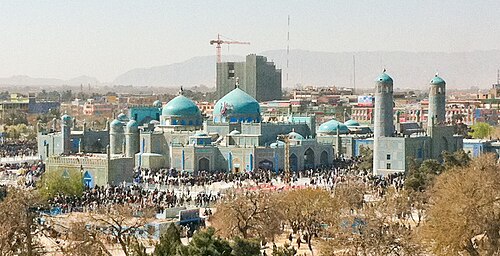
Mazār-e Sharīf, located in northern Afghanistan, is one of the country's largest cities and a significant cultural and economic center. The city is the capital of Balkh Province and has a rich history, dating back over two millennia. It is renowned for its historical sites, particularly the Shrine of Ali, a prominent pilgrimage site for Shia Muslims, believed to hold the remains of Ali ibn Abi Talib, the cousin and son-in-law of the Prophet Muhammad. This shrine, adorned with a distinctive turquoise dome, attracts visitors from across Afghanistan and beyond, making it a focal point of religious and cultural significance.
The geography of Mazār-e Sharīf plays a critical role in its historical importance as it serves as a strategic trade hub linking Central Asia with South Asia. Situated near the Amu Darya River, the city has been a crossroads for various cultures and civilizations throughout history, including the Macedonian empire, Persian empires, and the great Silk Road traders. The city has also witnessed significant events during the conflicts in Afghanistan, especially during the civil wars in the 1990s and the U.S. invasion in 2001. Today, Mazār-e Sharīf is undergoing transformation as it grapples with modernization while retaining its cultural heritage. Its economy is characterized by agriculture, trade, and small manufacturing enterprises, with local markets bustling with activity, showcasing a diverse array of traditional crafts and goods.
Despite its vibrant culture and historical depth, Mazār-e Sharīf faces ongoing challenges, including political instability and economic development issues. The city continues to be affected by the broader geopolitical dynamics of Afghanistan, especially following the resurgence of the Taliban in 2021. Nevertheless, the resilience of its people and the rich cultural tapestry contribute to Mazār-e Sharīf's significance as a center of hope and heritage in a tumultuous region. The city's vibrant mix of ethnicities, traditions, and historical narratives underscores its identity as a pivotal part of Afghanistan's past and future.
Facts about Mazār-e Sharīf
- Mazār-e Sharīf is home to the famous Blue Mosque, also known as the Shrine of Hazrat Ali, which is a significant pilgrimage site for Muslims and is adorned with stunning blue tiles.
- The city is one of the oldest in Afghanistan, with roots tracing back to the time of Alexander the Great, adding to its historical significance.
- Mazār-e Sharīf is renowned for the annual Nowruz festival, celebrating the Persian New Year, which attracts visitors and showcases the region's cultural richness.
- The city serves as the capital of Balkh Province and is considered a vital economic and cultural center in northern Afghanistan.
- Due to its strategic location, Mazār-e Sharīf has historically been a melting pot of various cultures and ethnicities, including Pashtuns, Tajiks, Uzbeks, and Hazaras.
- The city was a key location during the Afghan Civil War in the 1990s, with significant battles occurring in and around it that shaped the country's recent history.
- Mazār-e Sharīf's name translates to 'Tomb of the Sacred' in Persian, reflecting its association with Islamic history and reverence.
- The region around Mazār-e Sharīf is known for its agricultural output, particularly in the cultivation of fruits, nuts, and grains, making it an important food production area.
- The city has been a significant center for trade and commerce due to its proximity to Central Asia, facilitating cross-border exchanges and cultural interactions.
- Mazār-e Sharīf is often perceived as one of the more peaceful cities in Afghanistan, with a reputation for stability compared to other regions that have experienced ongoing conflict.