Nanchang, China
- 2,357,839 people
- 13 places to visit
- 28.682, 115.8579
Places to Visit (13)
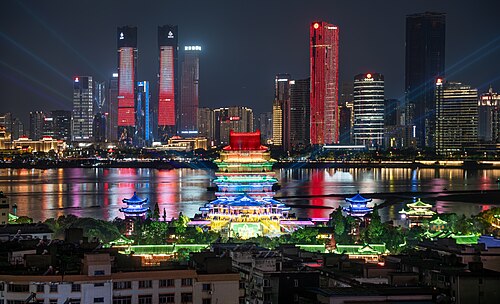
Nanchang, the capital of Jiangxi province in southeastern China, is a city rich in history and culture. Located on the banks of the Gan River, it is strategically positioned as a transport hub, connecting the Yangtze River basin with the Pearl River delta and adjacent southeastern coastal areas. Nanchang has a population of over 5 million residents in its urban area, making it one of the most populous cities in the region. The city's economy has seen rapid growth since the reform and opening-up period of the late 20th century, evolving from a primarily agricultural economy to a diverse industrial base that includes manufacturing, electronics, and services.
Historically, Nanchang is notable for its role in the early 20th century as a center of revolutionary activities. It was here that the Nanchang Uprising took place in August 1927, marking a significant event in the founding of the People's Liberation Army and the establishment of the Chinese Communist Party's military forces. As a result, the city is often recognized as a birthplace of the Communist military movement in China. In contemporary times, Nanchang is known for its cultural heritage, with several landmarks and sites of interest, such as the Tengwang Pavilion, a famous historical building that overlooks the Gan River. This pavilion, originally built in 653 AD, is renowned for its architectural beauty and has become a symbol of the city. Furthermore, Nanchang hosts various cultural and economic events and is home to several universities and research institutions, contributing to its reputation as a growing educational and technological center in the region.
The city is also well-regarded for its natural beauty, featuring scenic spots like Poyang Lake, the largest freshwater lake in China, which plays a crucial ecological role in the area. The climate in Nanchang is characterized by its subtropical monsoon influences, resulting in hot summers and mild winters. With ongoing urban development, infrastructure improvements, and investments in technology and education, Nanchang is positioning itself as a significant player in China's economic landscape, seeking to balance modernization with preservation of its historical and cultural identity.
Facts about Nanchang
- Nanchang is known as the birthplace of the People's Liberation Army, marked by the pivotal Nanchang Uprising in 1927.
- The city is home to the famous Tengwang Pavilion, one of the Four Great Towers of China, with a history dating back to 653 AD.
- Nanchang has a unique cultural heritage that blends both revolutionary history and traditional Chinese arts, making it a vibrant center of local culture.
- The city features the distinctive Qianhu Lake, renowned for its ecological beauty and diverse wildlife, making it a popular destination for nature lovers.
- Nanchang plays a critical role in China's aerospace industry, housing numerous research and manufacturing facilities involved in aviation and space exploration.
- The Raksha Dance, a traditional folk dance performed by locals, showcases Nanchang's rich cultural diversity and is unique to the region.
- Nanchang's July 1st Square is notable for being one of the largest public squares in China, serving as a central location for events and celebrations.
- The city is famous for its cuisine, particularly Nanchang rice noodles, which are a local staple and enjoyed by both residents and visitors.
- Nanchang is marked by the presence of the Nanchang Star, a large Ferris wheel that distinguishes the city's skyline and provides panoramic views of the area.
- The Gan River, which runs through Nanchang, is significant for its historical and economic role, and it provides scenic views as well as opportunities for recreational activities.