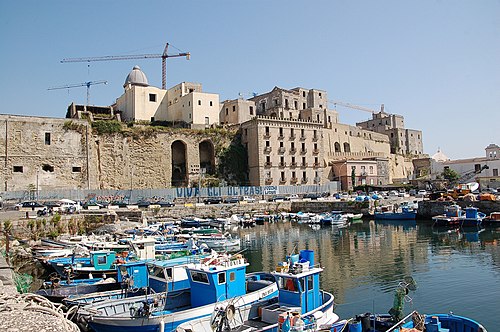
Pozzuoli, Italy

  • 81,231 people
  • 14 places to visit
  • 40.8346, 14.1086
Loading...

Places to Visit (14)

1. Solfatara Volcano
A dormant volcano with bubbling mud pools and sulfur vents.
2. Temple of Serapis
Ancient Roman temple ruins near the coast.
3. Flavian Amphitheater
One of the third largest Roman amphitheaters in Italy.
4. Pozzuoli Cathedral
Baroque-style cathedral with stunning interior frescoes.
5. Rione Terra
Historic district with underground tunnels and ancient ruins.
6. Bacoli
Charming seaside town with historic Roman ruins.
7. Agnano Hot Springs
Natural thermal springs used since ancient times for healing.
8. Monte Nuovo
Youngest volcano on mainland Europe with hiking trails.
9. Baia Archaeological Park
Ancient Roman thermal baths and ruins overlooking the sea.
10. Cuma Archaeological Park
One of the oldest Greek colonies in Italy with ruins of the Temple of Apollo.
11. Baths of Nero
Ruins of luxurious Roman baths attributed to Emperor Nero.
12. Gaiola Underwater Park
Marine protected area with underwater ruins and rich biodiversity.
13. Cave of the Sibyl
Mythical grotto where the Cumaean Sibyl was said to make prophecies.
14. Baia Castle
Medieval castle with panoramic views of the Bay of Pozzuoli.
Pozzuoli
Pozzuoli 2010-by-RaBoe-23© Ra Boe / Wikipedia Create the proper attribution for your usage by clicking on this button! This file is licensed under the Creative Commons Attribution-Share Alike 3.0 Germany license.Attribution: Ra Boe / Wikipedia You are free: to share – to copy, distribute and transmit the work to remix – to adapt the work Under the following conditions: attribution – You must give appropriate credit, provide a link to the license, and indicate if changes were made. You may do so in any reasonable manner, but not in any way that suggests the licensor endorses you or your use. share alike – If you remix, transform, or build upon the material, you must distribute your contributions under the same or compatible license as the original.https://creativecommons.org/licenses/by-sa/3.0/de/deed.enCC BY-SA 3.0 deCreative Commons Attribution-Share Alike 3.0 detruetrue Internet: Titel Foto: Ra Boe / Wikipedia, Original; Lizenz: CC by-sa 3.0 Print: Titel Foto: Ra Boe / Wikipedia, Lizenz: CC by-sa 3.0 I have published this image as author Ra Boe under the "CC-BY-SA-3.0" in Wikipedia. This means that free, commercial usage outside of Wikipedia is permitted under the following licence terms: Online media: The author " RaBoe/Wikipedia " is named A weblink to the original image is provided: //commons.wikimedia.org/wiki/File:Pozzuoli_2010-by-RaBoe-23.jpg A copy of, or the Uniform Resource Identifier (https://creativecommons.org/licenses/by-sa/3.0/de/legalcode) for, this License with every copy Print media: The author " RaBoe/Wikipedia" is named A copy of, or the Uniform Resource Identifier (https://creativecommons.org/licenses/by-sa/3.0/de/legalcode) for, this License with every copy Please send me a specimen copy or the URL of the website where the image is used. Please write an email to raboe001-at-web.de, if you need the image in a higher resolution need my postal address for sending a specimen copy have further questions about the terms of the licence PS: In case of refusal of the above terms the author reserves the right to take legal action. This license and the rights granted hereunder will terminate automatically upon any breach by you of the terms of this license. In this case the author reserves to demand declaration to cease and desist, and compensation (according to the MFM fee references currently in force). Any of the above conditions can be waived if you get permission from the copyright holder. Foto selbst aufgenommen mit Nikon-D50: Objektiv Tamron 18 - 250 mmvon Wikipedia-User: Ra Boe This photo was taken with an Nikon-D50:, Objective Tamron 18 - 250 mm by Wikipedia user: Ra BoeCC BY-SA 3.0 de

Pozzuoli is a coastal town located in the Campania region of Italy, approximately 10 kilometers west of Naples. Known for its rich historical significance and unique geological features, Pozzuoli has roots that trace back to ancient Roman times, when it was established as the Roman port of Puteoli. The town was a bustling commercial hub, especially known for its trade with the eastern Mediterranean and as a point of entry for goods from Greece and the East. Notable ancient landmarks include the well-preserved amphitheater, which is one of the largest in Italy, and the Temple of Serapis, a remarkable structure that played a crucial role in demonstrating the area’s volcanic activity through the differential erosion of its columns.

Today, Pozzuoli is celebrated not only for its archaeological treasures but also for its stunning natural surroundings, including views of the Bay of Naples and the nearby volcanic activity that shapes the landscape. The region is part of the Campi Flegrei volcanic complex, which encompasses numerous craters and thermal phenomena. Pozzuoli’s proximity to the Phlegraean Fields also allows for geothermal exploration and research, attracting scientists and tourists alike. The town has a vibrant cultural scene, with festivals, art galleries, and local markets that reflect its unique heritage. Culinary traditions thrive, particularly fresh seafood, influenced by its coastal location. The scenic beauty combined with historical depth makes Pozzuoli an attractive destination for both history enthusiasts and nature lovers, showcasing the interplay between ancient civilization and the dynamic environment that defines this remarkable area.

Facts about Pozzuoli

  • Pozzuoli is known for its Roman amphitheater, the Flavian Amphitheater, which is the third-largest in Italy, after the Colosseum and the Arena of Capua.
  • The city is situated in the volcanic area of Campi Flegrei and features a unique geological landscape, including bradyseism, which is the slow rising and sinking of the Earth's surface.
  • Pozzuoli is recognized for its ancient temple complex called the Temple of Serapis, often referred to as the Macellum of Pozzuoli, which showcases the city's rich history of Roman commerce.
  • The city hosts the annual 'Pozzuoli International Festival of Youth', celebrating talents in music and arts, making it an important cultural event in the region.
  • Pozzuoli was historically the port of the Roman Empire for goods traveling to the capital and served as a key trading hub in the Mediterranean.
  • The city’s coastline offers the only natural hot springs in the immediate vicinity, attracting visitors for therapeutic bathing and wellness.
  • Pozzuoli is famous for its seafood cuisine, particularly dishes featuring fresh fish and the local specialty called 'Impepata di Cozze', a peppered mussel dish.
  • The ancient Roman ruins, including the 'Roman Market' and the 'Nero's Temple', are well-preserved and provide insights into Roman life and architecture.
  • Pozzuoli is closely associated with the legendary poet Virgil, who is believed to have spent time in the area and wrote about its beauty in his works.
  • The city's bustling port is vital for ferry connections to the nearby islands of Ischia and Procida, making it an important transit point in the Bay of Naples.
Some of this text is AI generated and may not be accurate.