Samarkand, Uzbekistan
- 513,572 people
- 11 places to visit
- 39.6508, 66.9653
Places to Visit (11)
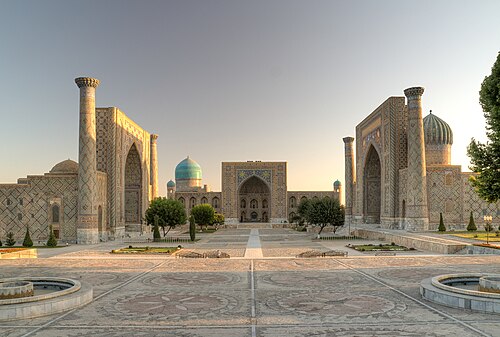
Samarkand, one of the oldest continuously inhabited cities in Central Asia, is located in present-day Uzbekistan. Founded around the 7th century BCE, it has been a key cultural and trade center for millennia, primarily known for its strategic position on the Silk Road, which linked China to the Mediterranean. The city's rich history reflects a blend of diverse cultures, including Persian, Greek, Arab, and Turkic influences. Noteworthy for its stunning architecture and historical monuments, Samarkand boasts UNESCO World Heritage sites such as the Registan Square, which features three magnificent madrasahs: Ulugh Beg Madrasah, Sher-Dor Madrasah, and Tilya-Kori Madrasah. These stunning examples of Islamic architecture reflect the city's significance during the Timurid Empire in the 14th and 15th centuries, under the rule of the famed conqueror Tamerlane.
The economy of Samarkand has historically been tied to trade, agriculture, and craftsmanship, with silk production and carpet-making acting as notable traditional industries. Today, tourism plays a critical role in the city's economy, drawing visitors eager to experience its rich heritage and vibrant bazaars. Moreover, Samarkand has embraced modernization while respecting its historical roots, offering a blend of ancient and contemporary lifestyles. The city's culinary traditions are also notable, with dishes like plov (a rice dish with meat and vegetables), manty (dumplings), and various breads, enhancing Samarkand's appeal. As a focal point of Islamic culture and education, Samarkand continues to captivate scholars, historians, and travelers from around the world, representing a remarkable chapter in the narrative of Central Asia.
Facts about Samarkand
- Samarkand is one of the oldest inhabited cities in Central Asia, with a history dating back over 2,500 years.
- It was a key point along the Silk Road, serving as a major trade center that connected the East and West.
- The city is famous for its stunning architectural landmarks, including the Registan, a UNESCO World Heritage site featuring three grand madrasahs.
- Samarkand is home to the Shah-i-Zinda necropolis, a complex of stunning mausoleums and tombs, which is considered one of the most beautiful sites in the Islamic world.
- The city has a rich cultural heritage that reflects a blend of Persian, Arab, and Turkic influences, distinct from other Uzbek cities.
- The observatory built by Ulugh Beg in the 15th century is one of the most significant contributions to the science of astronomy and remains a highlight of Samarkand's historical importance.
- Samarkand is known for its beautiful blue-tiled buildings and intricate mosaics, which are exceptional examples of Islamic architecture.
- The city has been a significant center for Islamic learning, and many notable scholars, poets, and philosophers have lived and worked here.
- Samarkand's local cuisine is unique, featuring dishes like plov, which is often prepared with a regional twist and is different from other parts of Uzbekistan.
- The city hosts the annual Silk Road Festival, celebrating its historical connections as a cultural crossroads, offering traditional music, dance, and crafts to locals and tourists alike.