San Marino, San Marino
- 4,500 people
- 15 places to visit
- 43.9306, 12.4438
Places to Visit (15)
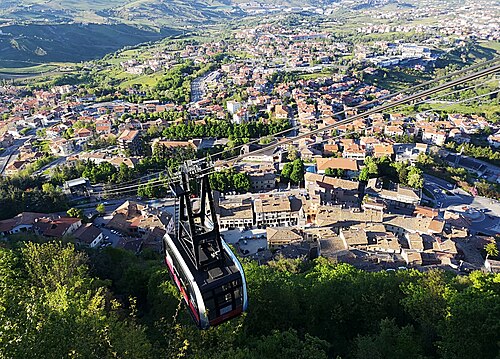
San Marino, officially known as the Republic of San Marino, is a landlocked sovereign city-state surrounded by Italy. It is one of the world's smallest countries, covering an area of just 61 square kilometers (24 square miles), and is situated atop Mount Titano, offering picturesque views over the surrounding landscape. Established in the year 301 AD, San Marino claims to be the world's oldest surviving republic, with a rich history that has allowed it to maintain its independence through various political upheavals in the region.
The capital city, also named San Marino, is characterized by its medieval architecture, cobblestone streets, and historic towers. One of the most iconic landmarks is Guaita, a fortress that dates back to the 11th century and is one of the three towers of San Marino. Visitors can explore other notable sites, such as the Basilica di San Marino, which is dedicated to the patron saint of the republic, and the Palazzo Pubblico, which houses the government and serves as a symbol of the republic's civic pride. The population of San Marino is around 34,000 residents, and despite its small size, the country boasts a vibrant culture, fueled by a commitment to preserving its traditions, including annual festivals and parades that celebrate its heritage.
Economically, San Marino relies on tourism, banking, and manufacturing sectors. The picturesque city attracts visitors with its rich cultural offerings, including museums, galleries, and historical sites. The economy is also supported by duty-free status on certain goods, making it an attractive destination for shopping. Due to its status as a microstate, San Marino maintains a strong sense of identity and governance, allowing it to operate independently while enjoying a peaceful coexistence with its neighboring Italian territories. As a UNESCO World Heritage Site, it continues to preserve its unique history and culture, making San Marino a fascinating destination for travelers interested in history and architecture.
Facts about San Marino
- San Marino is one of the world's oldest republics, founded in AD 301 by St. Marinus, who sought refuge from religious persecution.
- The Three Towers of San Marino, Guaita, Cesta, and Montale, are iconic landmarks that symbolize the city's fortifications and provide breathtaking views from their heights.
- San Marino holds the unique distinction of being a landlocked microstate surrounded entirely by Italy, making it one of the world's smallest sovereign states.
- The city is known for its medieval architecture, with the historic center of San Marino designated as a UNESCO World Heritage site in 2008.
- San Marino has its own national currency, the Sammarinese lira, which was used until it adopted the euro in 2002, alongside Italy.
- The City of San Marino has its own annual crossbow competition, the 'Palio dei Balestrieri,' celebrating a tradition that dates back to the 14th century.
- San Marino has a unique system of governance with a head of state that is rotated every six months between two Captains Regent, a practice rooted in its historic republican ideals.
- The city is home to the Basilica di San Marino, an important religious site that houses the relics of St. Marinus and reflects neoclassical architecture.
- San Marino has a high literacy rate and is known for its excellent education system, with a focus on both arts and sciences.
- The country boasts an impressive array of museums, including the San Marino Museum of Torture, which showcases historical weaponry and devices used in punishment.