Sinŭiju, North Korea
- 288,112 people
- 1 places to visit
- 40.0823, 124.4489
Places to Visit (1)
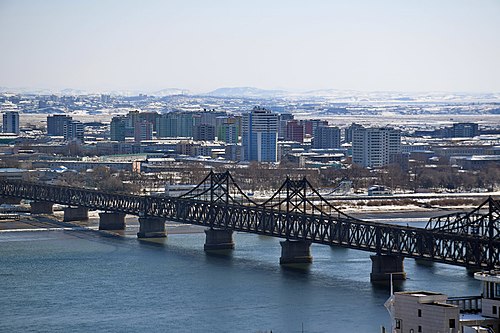
Sinŭiju is a city located in the northern part of North Korea, directly adjacent to the border with China. It stands on the banks of the Yalu River, which serves as the natural boundary between the two countries. Founded in 1910, Sinŭiju has historically been a significant hub due to its strategic location, playing a crucial role in trade and transportation. The city was designated as a special administrative region to promote economic development, attracting some foreign investment and serving as a gateway for cross-border commerce. This has allowed Sinŭiju to cultivate a unique economic environment relatively distinct from the rest of North Korea, where strict state control defines most aspects of life.
Modern Sinŭiju is characterized by its industrial base, including textile manufacturing, food processing, and light industries. The city is home to various state-owned enterprises and has also attempted to integrate elements of a market economy in recent years, despite the overarching influence of the government. Sinŭiju's population is approximately 300,000, composed primarily of ethnic Koreans. The city's cultural landscape reflects its political and social affiliations, with monuments, public squares, and government buildings emphasizing the ruling party's ideology. The economy, however, faces significant challenges due to international sanctions, exacerbated by the country's nuclear ambitions, limiting its potential for growth and development.
The relationship with China is particularly important for Sinŭiju. The city serves as a crucial point for trade and smuggling operations, as residents often engage in informal commerce across the border. This economic interdependence is vital for local livelihoods, given North Korea's economic isolation. Despite the hardships, Sinŭiju retains a sense of resilience among its inhabitants, showcasing an atmosphere that blends traditional Korean culture with modern influences, albeit under the constraints of a restrictive regime. As North Korea continues to navigate its complex geopolitical landscape, Sinŭiju remains a pivotal city for observing the interaction between state policy and local economic practices.
Facts about Sinŭiju
- Sinŭiju is located at the border of North Korea and China, making it a key point for trade and commerce.
- The city is known for its proximity to Dandong, China, across the Yalu River, which allows for significant cross-border interaction.
- Sinŭiju was established as a city in the early 20th century and was formally designated as a city in 1946 after World War II.
- It has a population of around 250,000, making it one of the more populous cities in North Korea.
- Sinŭiju features the Sinŭiju Cosmetic Factory, renowned for being one of the largest cosmetic producers in North Korea.
- The city has a unique historical significance as it was a major site for the Korean resistance against Japanese colonial rule.
- Sinŭiju is home to a number of cultural landmarks, including the Kim Il Sung Square, which is central for public events and celebrations.
- Unlike many other cities in North Korea, Sinŭiju has seen recent economic reforms aimed at encouraging market activities.
- There is a notable railway connection from Sinŭiju to Dandong, facilitating the movement of goods and people.
- Sinŭiju serves as a hub for the Special Economic Zone at Rajin-Sonbong, which is intended to promote foreign investments.