Toledo, Spain
- 84,282 people
- 19 places to visit
- 39.8628, -4.0273
Places to Visit (19)
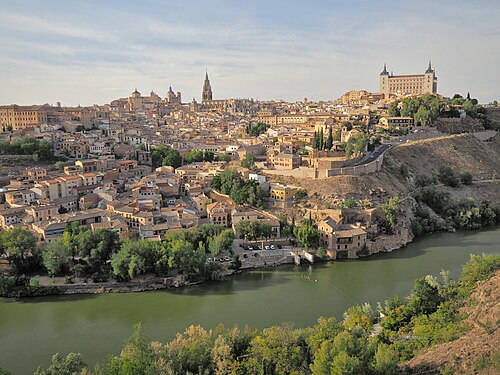
Toledo, a historic city in central Spain, is located on a hill overlooking the Tagus River and serves as the capital of the province of the same name in the autonomous community of Castilla-La Mancha. Known for its rich cultural heritage, Toledo has been designated a UNESCO World Heritage Site due to its extensive historical architecture and significant contributions to art and philosophy. The city's strategic location made it an important political and military center during the Visigothic kingdom, and later it became the capital of Spain until the court moved to Madrid in the 16th century. Its well-preserved medieval architecture reflects a blend of Christian, Muslim, and Jewish influences, showcasing the city’s diverse religious history.
Among Toledo's remarkable landmarks is the Alcázar, a stone fortification that has served various purposes throughout history, including a Roman palace and a military museum. Additionally, the stunning Toledo Cathedral, completed in the 13th century, is regarded as one of the finest examples of Gothic architecture in Spain. The city's winding streets are punctuated by other notable structures such as the Synagogue of Santa María la Blanca, the Mosque of Cristo de la Luz, and the numerous churches that highlight its coexistence of faiths. Toledo is also celebrated for its traditional craftsmanship, particularly in the production of damasco (a type of gold and silver embroidery) and the forging of blades, which date back to the Roman era. Today, the city attracts thousands of tourists each year, drawn by its historical allure and the opportunity to experience its vibrant local culture and gastronomy, characterized by dishes such as venado (venison) and marzipan, an iconic sweet that originated in the region.
Facts about Toledo
- Toledo is known as the 'City of Three Cultures' due to the historical coexistence of Christian, Muslim, and Jewish communities.
- The Alcázar of Toledo, a stone fortification, has served various purposes throughout history, including as a Roman palace, a fortress, and a military museum.
- Toledo is home to the third largest cathedral in Spain, the Toledo Cathedral, which is a prime example of Gothic architecture and contains works by famous artists.
- The city was declared a UNESCO World Heritage Site in 1986, recognized for its extensive historical legacy and well-preserved medieval architecture.
- El Greco, the famous painter, spent most of his life in Toledo, and the city features several museums and churches displaying his works.
- Toledo has a unique blend of cultural influences, including Mudejar, Gothic, Renaissance, and Baroque architecture seen in its numerous historic buildings.
- The Mazapán (marzipan) of Toledo is a famous confectionery with a long history, celebrated annually during the Feast of St. Ildefonso.
- Toledo's historic center is one of the few remaining medieval cities in Europe, with many ancient streets and buildings that have stood the test of time.
- The city has a rich sword-making tradition, dating back to Roman times, and is known for its high-quality steel and craftsmanship.
- Toledo was the capital of Spain until the 16th century, and its historical significance can be seen in its vast array of historical sites and museums.