Trier, Germany
- 100,129 people
- 13 places to visit
- 49.7501, 6.6372
Places to Visit (13)
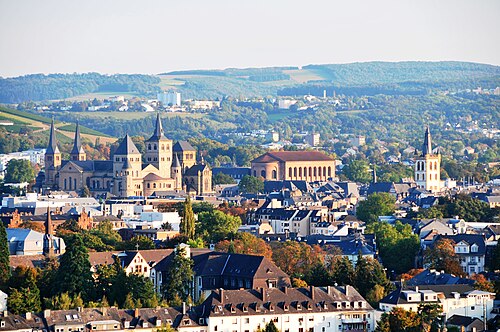
Trier, located in the southwest of Germany near the Moselle River, is one of the country’s oldest cities, with a history that stretches back over 2,000 years. Founded by the Romans around 16 BCE, Trier was known as Augusta Treverorum and served as an important administrative and cultural center in the Roman Empire. The city is renowned for its well-preserved Roman monuments, many of which have been designated as UNESCO World Heritage Sites. Among its most prominent structures are the Porta Nigra, a massive city gate that dates back to the 2nd century, the Roman amphitheater, and the imperial baths. These sites illustrate Trier's significance during Roman times and attract numerous tourists and historians alike.
Trier's rich history extends beyond its Roman roots, encompassing various periods, including the Middle Ages and the influence of the Prussian Empire. The city was the birthplace of Karl Marx in 1818, and it now hosts the Karl Marx House, which serves as a museum dedicated to his life and work. Beyond historical sites, Trier boasts a vibrant cultural scene, with numerous festivals, theaters, and galleries. The annual Trier Christmas Market draws visitors from across the region, offering traditional crafts and local delicacies. Furthermore, the city's picturesque location amidst vineyards along the Moselle River makes it popular for wine tourism, particularly for those interested in sampling the region's famous Riesling wines. Today, Trier combines its rich cultural heritage with modern amenities, making it a unique destination for both history enthusiasts and casual visitors.
Facts about Trier
- Trier is the oldest city in Germany, founded around 16 BC and known as Augusta Treverorum during the Roman Empire.
- The Porta Nigra, a well-preserved Roman city gate, is one of the most iconic landmarks in Trier and a UNESCO World Heritage Site.
- Trier is home to the oldest cathedral in Germany, the Trier Cathedral (Dom St. Peter), which dates back to the 4th century.
- The city was the birthplace of Karl Marx, the philosopher and revolutionary socialist, and there is a museum dedicated to his life and work in Trier.
- Trier has a rich Roman heritage, with numerous archaeological sites, including Roman baths, an amphitheater, and the Imperial Throne Room.
- The city celebrates its Roman history with the annual Roman Festival (Römerfest), attracting visitors to experience ancient Roman culture and traditions.
- Trier's Moselle wine region is renowned for its Riesling wines, with vineyards steeply terraced along the river, making it distinctive in Germany's wine culture.
- The Basilica of Constantine in Trier is one of the largest surviving Roman palaces and is notable for its impressive architecture.
- Trier is an important center for educational institutions, hosting the University of Trier, which specializes in a wide range of academic disciplines.
- The city features a unique blend of architectural styles, combining Roman, Gothic, and Baroque influences, which can be seen throughout its historic center.