Trieste, Italy
- 204,338 people
- 17 places to visit
- 45.6495, 13.7768
Places to Visit (17)
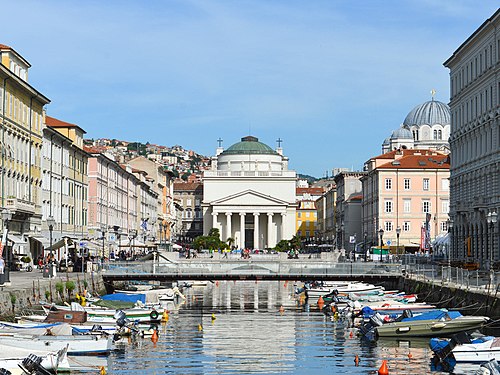
Trieste, a northeastern Italian city located at the head of the Gulf of Trieste on the Adriatic Sea, is renowned for its rich history, vibrant culture, and strategic position as a port city. With a population of approximately 200,000, Trieste serves as the capital of the Friuli Venezia Giulia region and is characterized by its unique blend of Italian, Slovenian, and Austrian influences, a reflection of its diverse historical past. The city became part of Italy after World War I but has retained many aspects of its Austro-Hungarian heritage, which are evident in its architecture, cuisine, and customs.
The architectural landscape of Trieste includes an eclectic mix of neo-classical buildings, grand palaces, and historic squares, making it a charming destination for visitors. Notable landmarks include the Piazza Unità d'Italia, one of the largest seafront squares in Europe, lined with stunning buildings and cafes. The city's prominent structures, such as the San Giusto Cathedral, the Castello di Miramare, and the Canal Grande, exemplify its artistic legacy. Trieste is also home to the historic Teatro Verdi and various museums, including the Museo Revoltella and the Museo del Mare, which celebrate its maritime past. The city has long been an intellectual hub, associated with famous figures such as the writer James Joyce, who spent considerable time in Trieste, contributing to its reputation as a center of cultural reflection and modernist thought.
Trieste's economy has historically been driven by its port, one of the most important in the Adriatic Sea, facilitating trade and commerce. In contemporary times, the city has diversified its economy, balancing traditional industries such as shipbuilding with service sectors, research, and the promotion of tourism. The annual Barcolana regatta, one of the largest sailing races in the world, serves as a major event that attracts visitors from across the globe. Additionally, Trieste is known for its coffee culture, with numerous historic cafés that reflect the city's cosmopolitan character. As a dynamic blend of history, culture, and modernity, Trieste remains a unique gem of Italy, inviting both locals and tourists to explore its rich tapestry of heritage and innovation.
Facts about Trieste
- Trieste was once the fourth-largest city of the Austro-Hungarian Empire and is known for its rich Habsburg history.
- The city is home to the historic Piazza Unità d'Italia, which is one of the largest sea-facing squares in Europe.
- Trieste has a unique blend of Italian, Slavic, and Germanic cultures, which is reflected in its architecture, cuisine, and customs.
- The city's coffee culture is legendary, featuring historic cafés like Caffè Tommaseo and Caffè San Marco, which were frequented by literary figures such as James Joyce and Italo Svevo.
- Trieste hosts the Barcolana regatta, one of the largest sailing regattas in the world, attracting thousands of sailors and spectators each year.
- The Miramare Castle, built for Archduke Ferdinand Maximilian of Austria, overlooks the Gulf of Trieste and is a significant historical landmark.
- Trieste is the base of the International Court for the Adriatic Sea and has a long-standing maritime tradition.
- The city has a significant presence of scientific research, highlighted by the presence of the International Centre for Theoretical Physics (ICTP) and the SISSA.
- Trieste is considered the 'City of Science,' with numerous museums, including the Museo di Storia Naturale and the Revoltella Museum for modern art.
- The local dialect, known as Triestine, is a mix of Italian, Slovenian, and German influences, distinguishing it from standard Italian dialects.