Verona, Italy
- 258,031 people
- 18 places to visit
- 45.4384, 10.9917
Places to Visit (18)
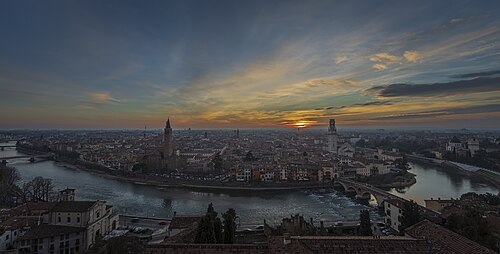
Verona, a city in northeastern Italy’s Veneto region, is renowned for its rich history, stunning architecture, and vibrant cultural scene. Located on the Adige River, Verona has a population of approximately 250,000 residents and covers an area of 206 square kilometers. The city’s origins date back to Roman times, making it a significant historical hub. The well-preserved Roman amphitheater, known as the Arena di Verona, stands as a testament to its illustrious past and serves as a venue for various performances, including opera, annually attracting thousands of visitors. Beyond Roman influence, the city showcases a blend of Gothic, medieval, and Renaissance architecture, with highlights including the stunning Castelvecchio, an impressive fortress, and the stunning Basilica di San Zeno, a prime example of Romanesque architecture.
Verona’s literary connection is profound, most notably due to its association with William Shakespeare. The city serves as the setting for two of his famous plays, "Romeo and Juliet" and "The Taming of the Shrew." The Casa di Giulietta, a house featuring a balcony, has become a popular tourist attraction, drawing those who wish to experience the romantic narrative of Juliet and Romeo. Verona is also famed for its vibrant piazzas, such as Piazza delle Erbe, which is surrounded by medieval buildings and lively markets, offering a taste of local life through its cafes and shops. The city hosts various festivals throughout the year, celebrating everything from wine to opera, further enhancing its cultural landscape.
Designated a UNESCO World Heritage Site in 2000, Verona's significance extends beyond its historical landmarks to include its role as a center for arts and gastronomy. The city is known for its excellent cuisine, characterized by local specialties such as risotto all'Amarone and pastissada de caval, paired with regional wines like Valpolicella and Soave. As a city that balances its historical treasures with modern vibrancy, Verona attracts millions of tourists annually, positioning itself as a city where history, romance, and culture converge seamlessly.
Facts about Verona
- Verona is home to the iconic Juliet's House (Casa di Giulietta), which features a famous balcony said to have inspired Shakespeare's 'Romeo and Juliet'.
- The city hosts the Verona Arena, a remarkably well-preserved Roman amphitheater that dates back to 30 AD and is still used today for opera performances and concerts.
- Verona's historic center is a UNESCO World Heritage site, recognized for its architecture and urban structure that showcases a blend of medieval and Renaissance styles.
- Verona is known for the annual Vinitaly fair, one of the largest wine fairs in the world, attracting wine professionals from across the globe to celebrate Italian winemaking.
- The city features the stunning Ponte Pietra, a Roman stone bridge that dates back to 100 BC, connecting the ancient part of the city to the modern side over the Adige River.
- Unlike many other Italian cities, Verona was ruled by several different powers throughout history, including the Romans, the Scaliger family, and the Venetians, which has contributed to its diverse cultural heritage.
- Verona is famous for its Scaliger Tombs, a group of Gothic funerary monuments that honor the powerful Scaliger family who ruled the city in the 13th and 14th centuries.
- The city celebrates the famous Verona Carnival, one of the largest and oldest carnivals in Italy, featuring parades, music, and a rich display of costumes and floats.
- Verona is situated near Lake Garda, the largest lake in Italy, making it a popular base for tourists who wish to explore the lake and surrounding regions.
- The city is also known for its love of opera, particularly through the 'Opera Festival' held each summer in the Verona Arena, attracting thousands to witness classical performances.