Wuwei, China
- 1,010,295 people
- 5 places to visit
- 37.9282, 102.638
Places to Visit (5)
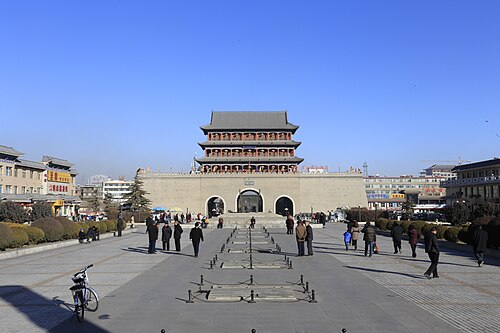
Wuwei is a city located in Gansu province, in the northwest part of China. It serves as an important administrative, cultural, and economic hub in the region. As of the most recent census, Wuwei has a population of around 700,000 people. The city covers an area of approximately 37,180 square kilometers and is situated at an elevation of about 1,500 meters above sea level. Wuwei's geography is characterized by its location within the hexagonal basin between the Yellow River and the Qilian Mountains, contributing to its arid climate and unique ecological environment. The city is known for its rich historical heritage, with evidence of human settlement dating back to the Han Dynasty (206 BC–220 AD).
Wuwei played a crucial role in the development of the ancient Silk Road, serving as a key stop for merchants traveling between the eastern and western parts of China. Today, this historical significance is reflected in various archaeological sites and cultural landmarks, such as the Wuwei Confucius Temple and the Grand Monument of the Silk Road. The city is home to several cultural relics, including the famous Leitai Han Tomb, which houses numerous artifacts, including the extraordinary bronze horse statue known as the "Flying Horse of Gansu." In addition to its cultural landmarks, Wuwei's economy is diverse, with agriculture, industry, and commerce playing significant roles. It is particularly known for producing agricultural products like grains, fruits, and livestock, taking advantage of its vast arable land.
In recent years, Wuwei has focused on improving infrastructure, enhancing tourism, and attracting investment, aiming to foster economic growth and improve the quality of life for its residents. The city is well-connected by road and rail, making it accessible for commerce and travel. As a regional center, Wuwei serves as a gateway to the historical and cultural riches of Gansu province, while also embracing modernization and development. The interplay of ancient history and contemporary advancements makes Wuwei a fascinating destination for both tourists and scholars interested in China's vast heritage and evolving landscape.
Facts about Wuwei
- Wuwei is known for its rich history as it was once the capital of the ancient Western Han Dynasty during the reign of Emperor Liu Che.
- The city is home to the famous Dafo Temple, which features the largest statue of Maitreya Buddha in Gansu Province.
- Wuwei is recognized as an important stop on the ancient Silk Road, serving as a trade hub connecting China with the West.
- The Wuwei Confucian Temple, which dates back to the Yuan Dynasty, is one of the largest and most well-preserved Confucian temples in western China.
- Wuwei is famous for its unique agricultural products, particularly its high-quality goji berries, a superfood known for its health benefits.
- The city is surrounded by the stunning Gobi Desert, providing it with diverse landscapes, including both arid and mountainous regions.
- Wuwei is known for its annual 'Wuwei International Goji Festival,' which celebrates the local goji berry harvest and promotes tourism.
- The city houses the Wuwei Museum, which showcases artifacts from the Silk Road, highlighting its historical significance in trade and culture.
- Wuwei's Lintao Mountain is revered in local lore, regarded as a spiritual site with several temples and shrines.
- The region around Wuwei is known for its ancient rock carvings and petroglyphs, which date back thousands of years, attracting archaeologists and tourists alike.