Zamość, Poland
- 66,034 people
- 11 places to visit
- 50.7231, 23.252
Places to Visit (11)
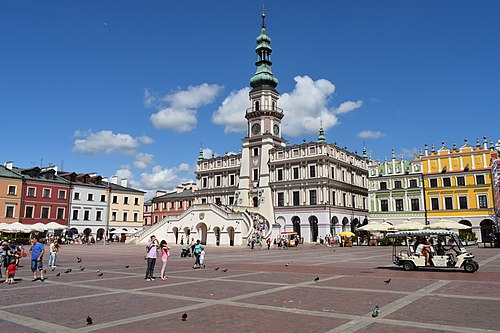
Zamość is a historically significant city located in southeastern Poland, renowned for its unique architectural heritage and urban planning. Founded in the late 16th century by Polish Chancellor Jan Zamoyski, the city was designed by the Italian architect Bernardo Morando. Zamość epitomizes the principles of Renaissance urbanism, featuring a well-planned layout that combines military, residential, and commercial areas. Its designation as a UNESCO World Heritage Site in 1992 underscores its importance as a model of a Renaissance town. The Old Town, characterized by colorful facades, arcaded streets, and the grand Zamość Cathedral, reflects the blend of various architectural styles influenced by Italian, Dutch, and Polish designs. The city's main square, the Great Market Square, is surrounded by elegant townhouses and civic structures, serving as a hub for cultural and social activities.
Throughout its history, Zamość has served as a significant administrative and economic center. It was a melting pot of various cultures, primarily due to its location on trade routes connecting Eastern and Western Europe. The city hosted Jewish, Armenian, and Serbian communities, all contributing to its cultural mosaic. Zamość was also notable for its university, founded in 1594, which emphasized education and legal studies, thereby helping to shape the region’s intellectual landscape. However, the city faced numerous challenges, including wars and political upheaval, especially during the partitions of Poland in the late 18th century and the turmoil of World War II. Despite these challenges, Zamość has preserved much of its historical fabric and today attracts visitors for its rich cultural offerings, including museums, festivals, and traditional markets. The surrounding landscape, with its lush greenery and nature reserves, adds to the city’s charm, making it a popular destination for both history enthusiasts and nature lovers.
Facts about Zamość
- Zamość was founded in the late 16th century by the Italian architect Bernardo Morando, designed as a 'ideal town' with a Renaissance style layout.
- The city is renowned for its beautiful, well-preserved Renaissance architecture, which has earned it the nickname 'The Pearl of the Renaissance'.
- Zamość is recognized as a UNESCO World Heritage Site due to its unique architecture and urban planning that blends Italian Renaissance and local influences.
- The Zamość Old Town features a Main Market Square surrounded by colorful townhouses and significant buildings, including the Zamość Cathedral and the Great Market.
- Zamość served as a significant cultural and academic center in the past, with the Zamość Academy, established in 1594, being one of the first universities in Poland.
- The city's fortifications include a remarkable star-shaped defensive system, which exemplifies advanced military architecture of the 16th century.
- Zamość hosts the annual Zamość Summer Festival, showcasing music, theater, and cultural arts, making it a vibrant cultural hub each summer.
- The Zamość Zoo is one of the oldest zoos in Poland, founded in 1910, and it is recognized for its conservation efforts and diverse animal species.
- Zamość is the birthplace of notable figures, including the famous Polish artist and graphic designer, Jan Józef Szczepkowski, and Cardinal Józef Glemp.
- The city is strategically located on historical trade routes and has served as a melting pot of cultures, including Polish, Armenian, Jewish, and Ukrainian influences.