At the bottom of the deepest trench on Earth, the survey found something that was on no chart: a button. Nobody knows who left it there. Naturally, somebody pressed it.
And the world turned over. Every height became a depth, and every depth became a height. The oceans drained into the continents, the trenches stood up as mountain ranges and every city on Earth ended up on the sea floor. Welcome to Atlantis, an explorer for the Earth turned upside down. You'll find it at atlantis.tripgeo.com, in your browser, with nothing to install.
Watch the trailer
Here's the 84-second version. Every shot was rendered straight out of Atlantis itself at 4K, flying the same globe and the same submersible you can take out yourself.
The chart of a world turned over
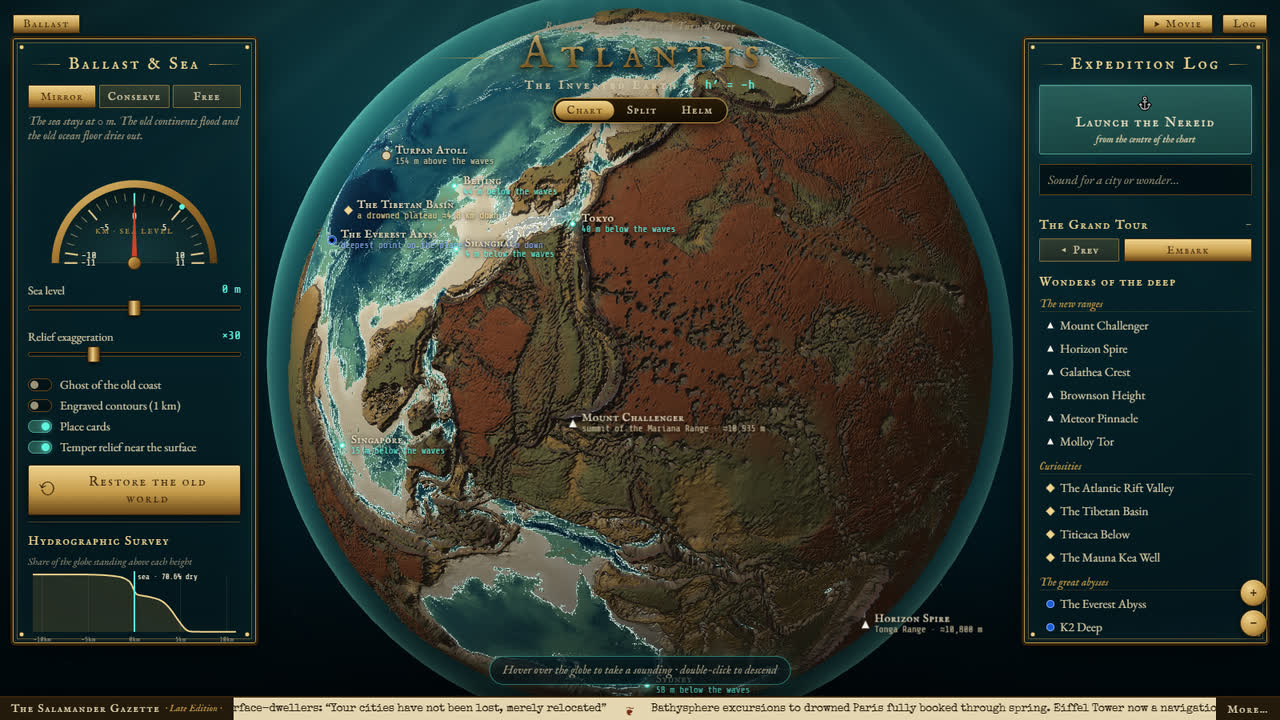
Atlantis opens on the chart: a globe built from real elevation and sea-floor data, then mirrored through sea level (h′ = −h, for anyone keeping score). The Pacific is now a vast, dry continent. The Mariana Trench is the highest mountain range on Earth, topped by Mount Challenger at 10,935 metres. Everest has become the Everest Abyss, 8,849 metres deep, and the Mid-Atlantic Ridge is now a rift valley 16,000 kilometres long. Before the button, 29.2% of the planet was dry land. Now it's 70.6%.
Hover anywhere to take a sounding, or follow the Grand Tour through 14 stops, from the Mariana Range to the Mauna Kea Well. The Ballast panel lets you play with the sea itself. Mirror keeps it at zero. Conserve pours today's oceans into the new world, and since the old continents can't hold all that water, the sea climbs kilometres up the new highlands. Free lets you set it anywhere from −11 to +11 kilometres. And if it all gets too much, there's a button to restore the old world. We'd still advise against pressing anything else.
Take the Nereid down to drowned Paris
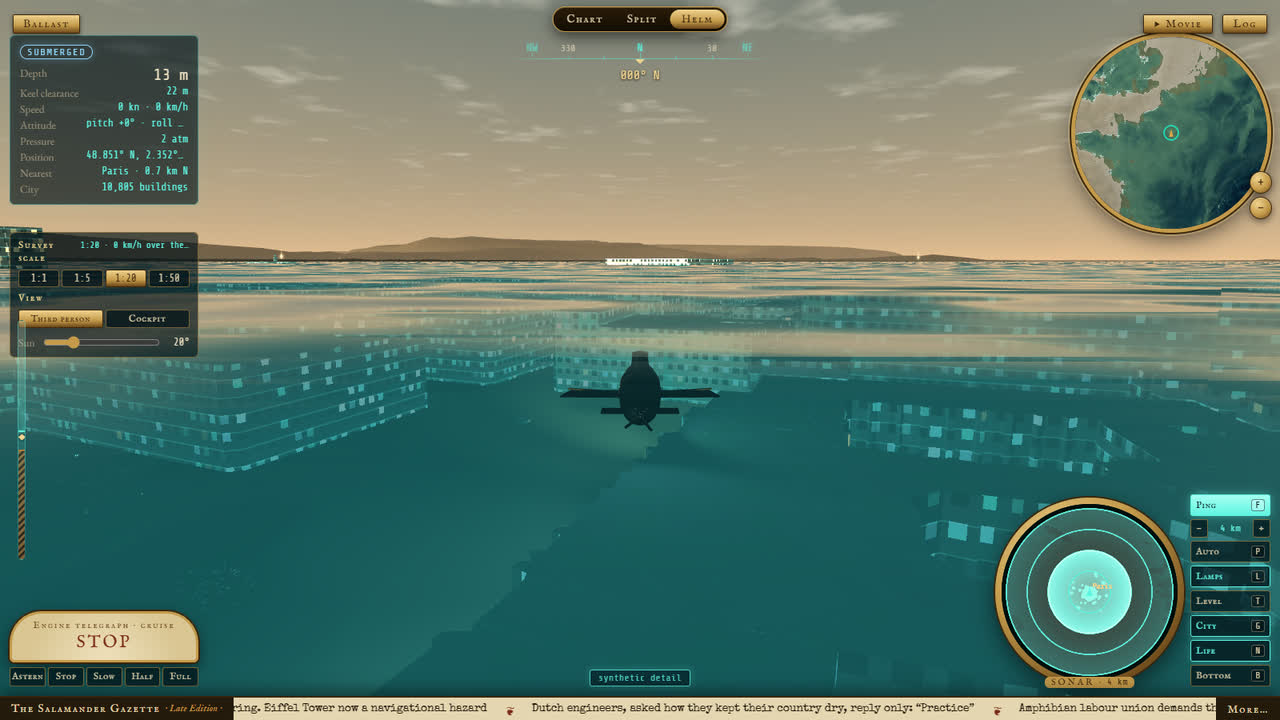
Click Launch the Nereid, or double-click anywhere on the globe, and you take the helm of a submersible airship commissioned to chart what was lost. She flies over the new continents and dives below the waves, with lamps, a sonar that reaches out to 16 kilometres, an engine telegraph and an Overdrive for when you're in a hurry. Switch to the cockpit and you can walk about her observation deck too.
Every city on Earth now lies on the sea floor, and the buildings are real, drawn from OpenStreetMap. Paris lies 35 metres below the waves, with more than 10,000 buildings to bump into, and Notre-Dame still keeps her towers above the water. Just. Chamonix is a kilometre down in the dark of the Alpine Trench, which is where the sonar really earns its keep.
The deep has found new tenants
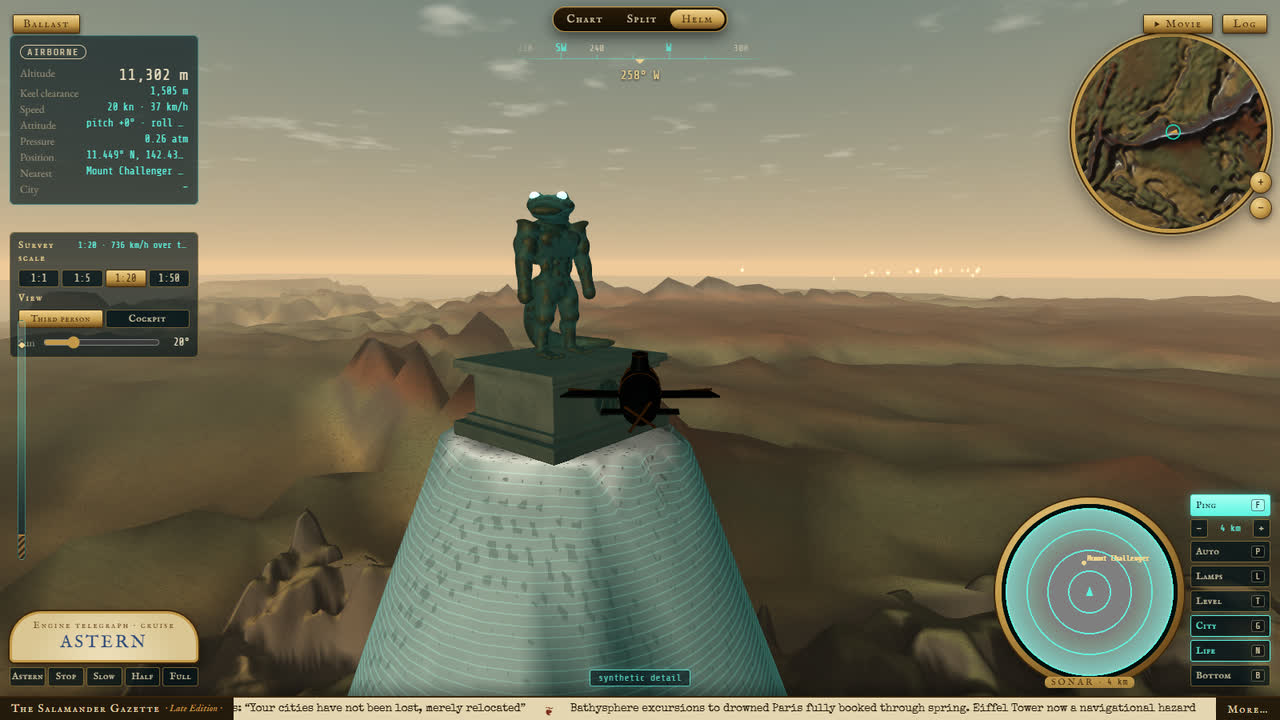
The new seas are filling up with fish, rays, jellies and the occasional giant of the deep. Up on the summit of Mount Challenger, where the button once lay, stands a colossal bronze newt. Its sculptor insists that it doesn't move. Ping it with the sonar anyway and see what you think. The Salamander Gazette keeps you up to date along the bottom of the screen, with news such as the Dutch engineers who, asked how they kept their country dry, would only say, "Practice."
Atlantis plays best in a desktop browser with a keyboard and mouse. It's built with three.js, on elevation data from the AWS Terrain Tiles and NOAA.
The world has been turned over, and somebody has to chart it. Explore Atlantis at atlantis.tripgeo.com, and if you'd like to hear what's next, tick Receive Newsletter at the top of the blog. Ideas and bug reports are always welcome on our contact page.